Electronic Shelf Label
Analysis of core technology of Electronic Shelf Labeling (ESL)
I. Overview
Electronic Shelf Labels (ESL) are loT-based intelligent display terminals that replace traditional paper price tags. They connect to a store's backend system via wireless communication to automatically update product prices, specifications, inventory, promotions, and other information. ESLs are a core hardware component driving digital transformation in retail.

II. System Architecture and Working Principle
|
Module |
Function |
|
Backend Management Platform |
Edits product information and sends update commands to in-store base stations via Ethernet or the cloud. |
|
Wireless Communication Base Station |
Uses Bluetooth 5.0/5.4, 2.4GHz proprietary protocols, or Zigbee to transmit commands to the corresponding ESL tags. |
|
ESL Tag Terminal |
The MCU (Microcontroller Unit) receives and verifies the command, drives the display to refresh, and reports the execution result back to the backend. |
|
Handheld PDA |
Scans barcodes locally, verifies and modifies tag information, and assists with picking, restocking, and inventory counting, often using the tag's LED for guidance. |
Display Technology. Electronic Paper Display (EPD)
Mainstream commercial ESLs utilize Electronic Paper Displays (EPD). Their core advantage stems from the bistable physical property—power is consumed only during screen refresh; static display consumes negligible power. This feature significantly reduces the need for frequent battery replacements, lowering store maintenance costs.
Additionally, EPDs offer a 180° wide viewing angle, remain clearly readable under bright light, produce no blue light, and are gentle on the eyes. These characteristics make them perfectly suited for the bright lighting and prolonged static display conditions common in retail environments. Only in a few scenarios requiring full-color dynamic marketing are low-power LCD screens used as a supplement.
Technology Trend Note: Traditional black-and-white EPDs have a refresh time of about 2–10 seconds. In recent years, “fast refresh screen” technology has been commercially adopted, reducing refresh times to between 300 ms and 3 seconds, catering to high-frequency price change scenarios like fresh produce and promotions.
III. Infrared + RGB 4-in-1 LED
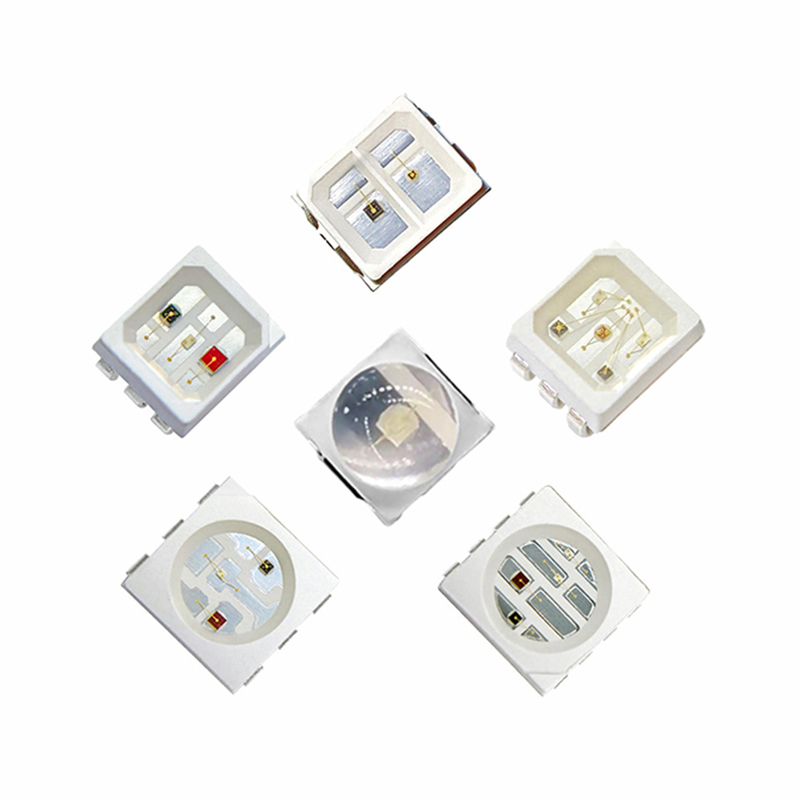
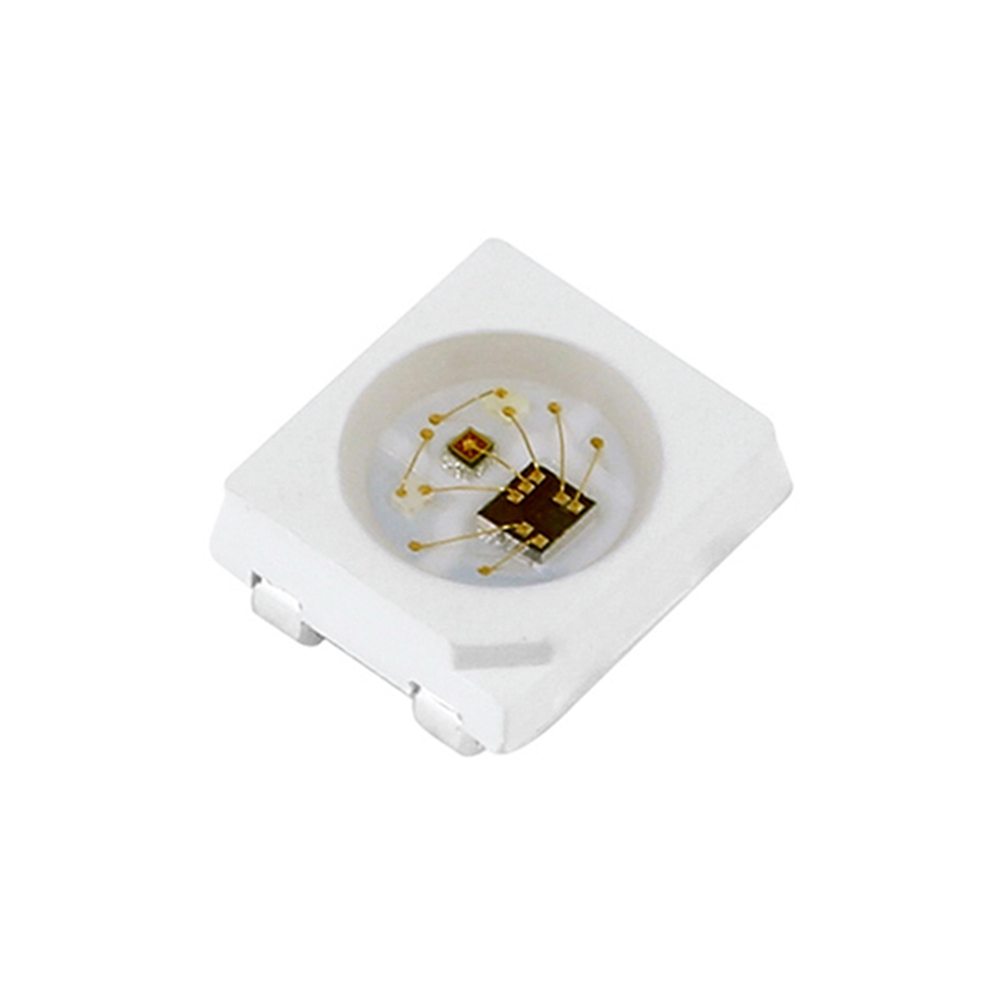
This 4-in-1 LED integrates one infrared (IR) chip and three visible light chips (Red, Green, Blue) into a single SMD package. It is a core component enabling extended ESL functions such as positioning, interaction, and alerts.
(A) Infrared (IR) LED
The IR LED primarilyauxiliarypositioninglocalservesvisualandcommunication functions:
Auxiliary Visual Positioning: Paired with an overhead camera system, the IR LED flashes at a specific frequency. The camera captures these flashing points and, combined with image recognition algorithms, precisely calculates the tag’s physical location or verifies its displayed content. This enables automated inventory checks and location verification.
Anti-Interference Local Communication: Pairs with the IR module on a handheld PDA for short-range point-to-point data transmission, tag wake-up, and information verification, avoiding radio frequency interference.
Intelligent Ambient Sensing: Works with light sensors to detect ambient light and automatically adjust RGB LED brightness. Advanced solutions also support human proximity sensing to trigger the LED or brighten the screen.
(B) RGB Tri-Color LEDs
RGB LEDs achieve full-color illumination and customizable flashing patterns by adjusting the current to the three chips. Their core value is realized in both operational efficiency and marketing.
Operational Value
|
Application |
Description |
|
Light-Assisted Picking/Replenishment |
After receiving an order, corresponding tags flash or stay lit in a specified color, guiding pickers to items quickly and reducing picking time. |
|
Inventory & Anomaly Alerts |
Integrated with Warehouse Management Systems (WMS) , triggers specific colors (e.g., red for out-of-stock, yellow for nearing expiration) for low inventory, expiring items, or misplaced products. |
|
Efficient Inventory Counting |
LEDs guide staff to locate items for counting; used with PDA scanning to shorten inventory cycles and reduce error rates. |
Marketing Value
|
Application |
Description |
|
Promotion & Traffic Attraction |
Flagship or limited-time discount products use custom colors (e.g., promotional red) and flashing patterns to grab customer attention. |
|
Scenario-Based Guided Selling |
LEDs of the same color illuminate related items (e.g., baby formula + bottles), suggesting bundled purchases and increasing average transaction value. |
|
Interactive Engagement |
Scanning a code triggers interactive LED responses, guiding customers to view product origins, member discounts, or other information. |
(C) Synergistic Advantages of the 4-in-1 LED
Space Optimization: The 4-in-1 package saves PCB space, simplifies circuitry, and reduces failure rates.
Low Power Consumption: Shares driving circuitry; individual chips can be turned on/off and dimmed independently, remaining completely off when not in use.
Function Integration: Combines positioning, communication, alerts, picking assistance, marketing, and other multi-dimensional functions into one compact component.
IV. Self-Developed Product: 3528 RGBI SMD LED (Infrared + RGB 4-in-1 Integrated LED)
Our independently developed 3528 RGBI SMD LED achieves technological breakthroughs in packaging structure, chip integration, and process reliability through several innovative designs. Its performance and reliability lead the industry, making it a preferred component for high-end ESL solutions.
This product has been co-developed with a leading international company for their ESL solution for over 15 years. Combined with their indoor geolocation system (Bluetooth beacons + smartphone mapping), it provides retailers with a complete digital shelf solution encompassing hardware and location-based services.

Product Features & Advantages
|
Feature |
Advantage |
|
Flat Lead Design |
Changed from traditional folded leads to flat leads, reducing height, increasing heat dissipation area, and improving chip lifespan. |
|
Embedded IR Chip |
Adjusts chip layout to embed the infrared emitter, reducing subsequent application costs. |
|
Special Encapsulation Formulation |
Uses a specialized silicone resin formulation, refined through extensive testing, to improve product longevity. |
|
Top/Bottom Mounting Flexibility |
The flat lead design allows the component to be mounted in reverse orientation, accommodating special application requirements. |
V. Conclusion
ESLs are evolving from simple price display terminals into intelligent retail endpoints integrating display, positioning, communication, interaction, and alert functions. The infrared + RGB 4-in-1 LED serves as a key component, leveraging IR for auxiliary visual positioning and RGB to empower picking and marketing, thereby significantly enhancing store operational efficiency and customer experience. With the maturity of high-performance components like the 3528 RGBI SMD LED, ESL systems are poised to further reduce power consumption and improve reliability, solidifying their role as critical infrastructure for retail digital transformation.
Smoke Alarm
Membrane Switches