850nm vs 940nm Infrared LED
850nm vs 940nm Infrared LED: Key Differences & Selection Guide
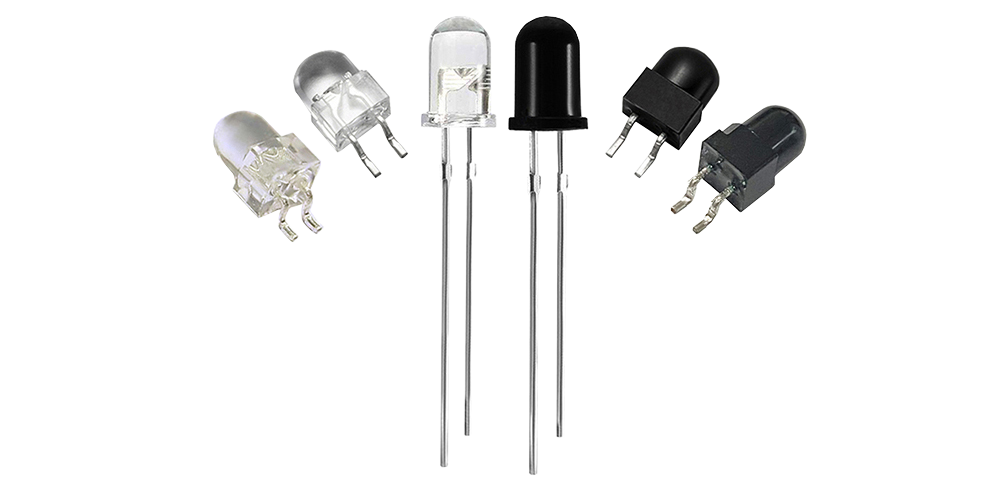
Infrared LEDs (IR LEDs) are essential components in modern optoelectronics, emitting light in the 780 nm to 1 mm wavelength range—invisible to the human eye but highly efficient for sensing and illumination. They power applications from security cameras to remote controls, industrial sensors, and medical devices. Among the various IR wavelengths available (730nm, 810nm, 830nm, 870nm, 905nm, etc.), 850nm and 940nm are the most widely used. But how do you choose between them? This guide breaks down their core differences, performance characteristics, and ideal use cases to help you make an informed decision.
Core Differences Between 850nm and 940nm IR LEDs
| Parameter | 850nm IR LED | 940nm IR LED |
|---|---|---|
| Wavelength | Shorter (850 nm) | Longer (940 nm) |
| Red Glow (Visible Light Leakage) | Slight red glow visible at close range | Completely invisible; no red glow |
| Radiant Intensity / Efficiency | ~2–3× higher than 940nm | Lower, but improving with advanced designs |
| Penetration (Fog, Dust, Smoke) | Moderate; susceptible to scattering | Superior; longer wavelength penetrates airborne particles better |
| Illumination Coverage | Wider coverage area due to higher output | Narrower coverage, but can be compensated with multiple emitters |
| Sensor Sensitivity | Most CMOS/CCD sensors have peak sensitivity near 850nm | Lower sensitivity, often requires higher drive current or more LEDs |
1. Wavelength & Visual Appearance
- 850nm IR LEDs emit light that is nearly invisible, but at close range or high power, a faint red glow (often called "red glow" or "red sneak") can be seen. This is because the wavelength is close to the visible spectrum.
- 940nm IR LEDs are truly invisible—no red glow at all. They offer maximum covertness, ideal for applications where undetectable illumination is critical.
2. Radiant Intensity & Efficiency
Due to the inherent properties of semiconductor materials, 850nm IR LEDs typically deliver 2 to 3 times higher radiant intensity than 940nm LEDs at the same drive current. This means:
- For a given power, 850nm provides brighter illumination and wider coverage.
- 940nm designs may require more LEDs or higher current to achieve similar illumination levels, impacting power consumption and thermal management.
3. Penetration Through Atmospheric Particles
Longer wavelengths scatter less in hazy, dusty, or smoky environments. Therefore:
- 940nm IR LEDs maintain better signal stability in challenging conditions (e.g., outdoor fog, industrial dust), making them the preferred choice for outdoor surveillance and industrial sensing.
- 850nm IR LEDs are more susceptible to scattering, but their higher output often compensates in clear conditions.
4. Sensor Compatibility
Most standard CMOS and CCD image sensors used in security cameras have peak sensitivity around 850nm. This means:
- 850nm yields brighter images with less LED power.
- 940nm falls on the tail end of sensor sensitivity, so achieving comparable brightness requires more optical power. However, specialized sensors or higher‑output 940nm LEDs can overcome this.
Technical Insights: Why These Differences Matter
- Red Glow (Red Sneak): The slight red glow from 850nm LEDs is due to the tail of the emission spectrum extending just into visible red. While often negligible, it can be a concern in covert surveillance or when IR illumination must remain undetected.
- Atmospheric Window: The 940nm wavelength lies in an atmospheric transmission window where water vapor absorption is low, further enhancing its performance in humid or foggy conditions.
- LED Efficiency Trends: Recent advances in epitaxial design have narrowed the efficiency gap; high‑power 940nm LEDs now approach the output of 850nm devices, though 850nm still leads in raw intensity.
Application Scenarios: Which One to Choose?
When to Choose 850nm IR LEDs
- Security Cameras & Night Vision: Ideal for general surveillance where slight red glow is acceptable (e.g., indoor cameras, perimeter lighting). Higher output means fewer LEDs and simpler designs.
- Machine Vision & Industrial Inspection: Bright illumination for high‑speed imaging in controlled environments.
- Consumer Electronics: Remote controls, gesture recognition, and IR blasters where cost and efficiency are key.
When to Choose 940nm IR LEDs
- Covert Surveillance: Police body cameras, wildlife monitoring, or any application where invisible illumination is mandatory.
- Outdoor & Harsh Environments: Traffic cameras, perimeter security in foggy regions, or industrial areas with dust/smoke.
- Medical & Biometric Devices: Heart rate monitors, pulse oximeters, and touchless sensors where low noise and minimal visible light are required.
- Interactive Whiteboards & Touch Frames: Eliminates any distracting red glow in educational or corporate settings.
How to Select the Right IR LED for Your Project
- Assess Covertness Needs: If absolutely no visible light is allowed, choose 940nm.
- Evaluate Environmental Conditions: For outdoor use with fog, dust, or smoke, 940nm offers better reliability.
- Consider Sensor Sensitivity: Match the LED wavelength to your sensor’s peak response for optimal efficiency.
- Calculate Illumination Requirements: 850nm provides more coverage per LED, potentially reducing BOM cost.
- Check Power Budget & Thermal Constraints: 940nm may need more emitters or higher drive current; ensure your system can handle it.
Why Choose WEJ Infrared LEDs?
With over 25 years of experience in semiconductor optoelectronics, Yong'erjia delivers high‑reliability infrared LED solutions tailored to your application. Our 850nm and 940nm IR LEDs undergo rigorous quality control to ensure consistent performance, long lifespan, and precise wavelength tolerance. Whether you need wide‑coverage 850nm emitters for security cameras or fully covert 940nm LEDs for medical devices, we provide the right product—backed by technical expertise and global supply capability.
Our infrared LED range includes several viable alternatives to OSRAM products.
Explore our IR LED portfolio or contact our engineering team for personalized selection assistance and samples.
The Impact of SMD LED on Display Screens
What is the price difference between SMD LED?